
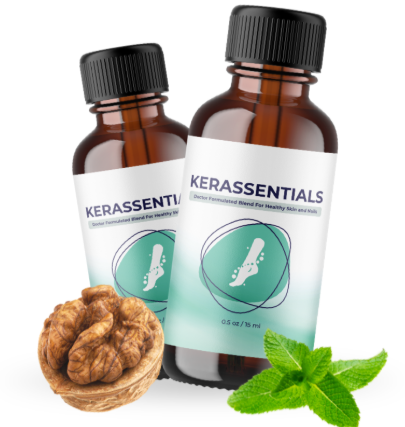
Dealing with nail or skin concerns that just don’t seem to improve — despite trying various creams, gels, or home remedies — is frustrating and common. Kerassentials is a topical oil-drop formula built around a broad blend of carrier oils and essential oils, several of which have genuine research behind general antifungal and antioxidant properties — including, for a few specific ingredients, actual clinical research in people with nail fungal conditions.
Here’s exactly what’s in it, what the research shows (and its real limits), and what to realistically expect.
What Is Kerassentials?
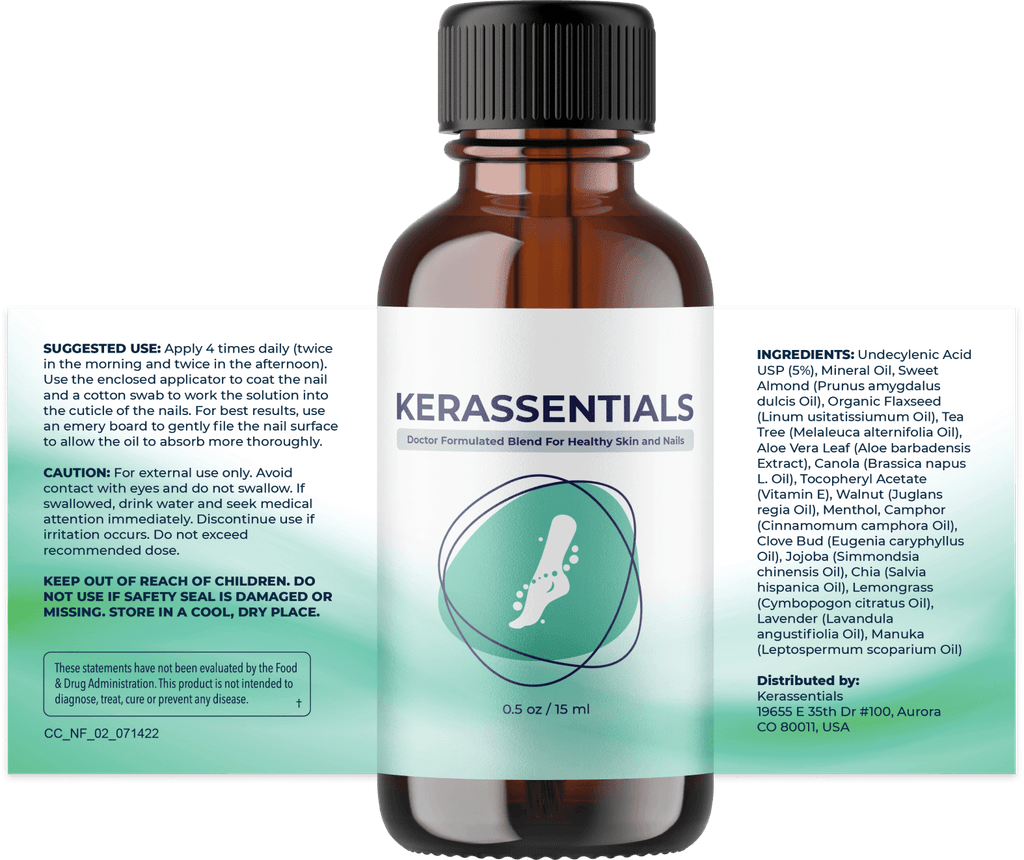
Kerassentials is a topical oil drop formula (0.5 oz / 15 ml) applied with an included applicator, combining:
Carrier & Nourishing Oils
- Mineral Oil, Sweet Almond Oil, Organic Flaxseed Oil, Canola Oil, Walnut Oil, Jojoba Oil, Chia Oil — A broad group of oils used for their moisturizing, emollient properties. Flaxseed in particular has documented antibacterial and antifungal research (Narender et al., 2016; Goyal et al., 2014), and chia seed oil has shown antimicrobial activity in lab studies (Elshafie et al., 2018; Güzel et al., 2020).
Active Botanical Oils
- Tea Tree Oil — The most clinically evaluated ingredient in this formula for nail fungal conditions specifically: a 2017 study (AbdelHamid et al.) evaluated tea tree oil’s therapeutic efficacy in treating onychomycosis directly, and a broader review (Yadav et al., 2017) covers its established antimicrobial research base.
- Lavender Oil — An in-vitro study (Behmanesh et al., 2015) compared lavender essential oil against the prescription antifungal clotrimazole on Candida albicans in a lab setting.
- Clove Bud Oil — Laboratory research (Chee & Lee, 2007; Eman-Abdeen & El-Diasty, 2015) found antifungal activity against dermatophyte fungi specifically.
- Camphor Oil — Lab research (Huo et al.; Pragadheesh et al., 2013) has looked at its antifungal activity.
- Menthol — Notably, a 2011 clinical case series (Derby et al.) looked at an over-the-counter mentholated ointment as a novel onychomycosis treatment approach — real clinical observation in patients, though a case series (no control group).
- Manuka Oil — Researched (Chen et al., 2016) for antimicrobial and anti-inflammatory activity against infectious microorganisms in vitro.
- Lemongrass Oil — Carries traditional and some researched antimicrobial properties.
Vitamins & Additional Ingredients
- Tocopheryl Acetate (Vitamin E) — Beyond general antioxidant use, a small clinical report (Williams et al., 1991) documented topical vitamin E’s use for nail changes in a specific condition (yellow nail syndrome, not fungal infection) — relevant mainly as evidence vitamin E has a history of topical nail-related clinical use.
- Aloe Vera Leaf Extract — An in-vitro study (Saniasiaya et al., 2017) found antifungal activity against select fungal species in culture.
- Undecylenic Acid USP (5%) — An FDA-recognized OTC active ingredient for certain fungal skin infections. A clinical research paper (Rehder & Nguyen, 2008) specifically looked at a topical onychomycosis treatment approach combining undecylenic acid with other compounds — among the more direct, human-focused evidence in this ingredient list.
What the Research Actually Shows (and Its Real Limits)
This formula’s ingredient list is backed by an unusually wide range of published research — including some genuine clinical (human) evidence, not just lab studies. The most notable: an open clinical study (Alessandrini et al., 2020, Skin Appendage Disorders) evaluated a nail oil combining vitamin E and essential oils in patients with mild-to-moderate distal subungual onychomycosis (a common type of toenail fungus) and reported positive effectiveness and tolerability.
It’s important to understand exactly what that means and doesn’t mean:
- “Open study” and “case series” are weaker study designs than a randomized, placebo-controlled trial — they typically lack a control group, meaning results could be influenced by factors other than the treatment itself. They’re genuine clinical observations, but not the gold standard of proof.
- None of these studies tested the Kerassentials product itself — they tested similar but not identical formulations (for example, “a nail oil composed of vitamin E and essential oils,” not this specific product’s exact blend and concentrations).
- Separately, there’s well-established medical literature (Perlin et al., 2017, The Lancet Infectious Diseases; Eliopoulos et al., 2002) on antifungal resistance — confirming that incomplete antifungal treatment is a genuine, documented clinical concern. This is real, important context, but it does not mean a cosmetic oil product solves or prevents that resistance; the actual recommendation from this literature is to complete prescribed treatment as directed, not to substitute it.
A quick honest note: Kerassentials is a topical cosmetic/wellness product for external use only. While several of its ingredients have real clinical and laboratory research behind general antifungal and nail-health properties — more than most products in this category — it has not been clinically tested as this exact finished product, and it is not a substitute for a doctor-prescribed antifungal treatment. If you’re currently under treatment for a diagnosed fungal infection, complete that treatment as directed. If you suspect a new infection, see a doctor or podiatrist for proper diagnosis first — nail fungal infections (onychomycosis) can be genuinely difficult to treat due to how the nail plate limits topical absorption (Christenson et al., 2018; Monod & Méhul, 2019), which is exactly why medical guidance matters.
Key Benefits
- Supports nail and skin moisture — The broad carrier oil blend combats dryness and brittleness.
- Antioxidant and skin support — Vitamin E and Aloe Vera contribute antioxidant and soothing properties.
- Botanicals with clinical and laboratory antifungal research — Tea tree oil in particular has been directly studied in an onychomycosis treatment context, alongside several other oils with supporting lab research.
- Contains a recognized OTC antifungal ingredient — Undecylenic Acid, at a labeled 5% concentration, also has supporting clinical research in a nail fungal treatment context.
- Soothing, cooling application — Menthol and Camphor provide an immediate cooling sensation, and menthol specifically has been observed in a small clinical case series for onychomycosis.
Who This Is For
- Adults dealing with dry, rough, or generally unhealthy-looking nails and skin, looking for a well-researched topical oil blend
- Anyone interested in ingredients with genuine clinical (not just laboratory) research behind nail health, like tea tree oil and vitamin E/essential oil nail formulas
- People who prefer a natural, plant-based topical as part of a broader nail and skin care routine
Who Might Want to Skip It
- Anyone currently undergoing prescribed antifungal treatment should complete that treatment as directed rather than substituting or combining it with this product without medical guidance
- Anyone with a suspected new fungal infection should see a doctor or podiatrist for proper diagnosis first, given how difficult nail fungal infections can be to resolve without appropriate treatment
- Anyone with known sensitivities to essential oils should patch-test first
- Anyone with a tree nut allergy should check the label, given the almond and walnut oil content
- Pregnant or nursing individuals should check with a doctor before use
How to Use It
Per the label: apply 4 times daily (twice in the morning, twice in the afternoon), using the enclosed applicator to coat the nail and a cotton swab to work the solution into the cuticle. For best results, gently file the nail surface with an emery board to help absorption. For external use only — avoid contact with eyes, do not swallow, and discontinue if irritation occurs.
Pros and Cons
Pros
- Several ingredients (tea tree oil, vitamin E/essential oil combinations, undecylenic acid, menthol) have actual clinical research in nail fungal treatment contexts, not just lab studies
- Includes Undecylenic Acid at a labeled, FDA-recognized concentration (5%)
- Detailed application instructions with included applicator
- Non-GMO, plant-based formulation
Cons
- The supporting clinical studies are small, open-label, or case-series designs — not large randomized controlled trials
- None of the cited research tested this exact product
- Nail plate structure genuinely limits how effectively any topical can treat an established fungal infection
- Frequent application schedule (4x daily) requires real consistency
- Contains tree nut oils — a concern for related allergies
Frequently Asked Questions
Is there real science behind these ingredients?
Yes, more than most products in this category — several ingredients (tea tree oil, vitamin E combined with essential oils, undecylenic acid, menthol) have been studied in actual clinical settings with onychomycosis patients, not just in lab dishes. That said, these were small studies (open-label or case series), not large controlled trials, and didn’t test this exact product.
Can Kerassentials replace my prescribed antifungal medication?
No. If you’re currently being treated for a diagnosed fungal infection, complete that treatment as directed by your doctor. Antifungal resistance is a well-documented medical concern tied to incomplete treatment — the solution is finishing prescribed care.
How strong is the evidence, really?
Stronger than typical for this product category, but still limited. “Open study” and “case series” designs are genuine clinical observations in real patients, but without a control group, so it’s hard to rule out other factors. Treat this as promising, legitimate supporting evidence — not definitive proof.
How long until I see results?
Since nails grow gradually, changes in appearance from consistent use would typically be evaluated over several weeks to months.
Final Verdict
Kerassentials stands out for combining ingredients that go beyond typical lab-only research — tea tree oil, vitamin E paired with essential oils, undecylenic acid, and menthol all have some genuine clinical observation behind them in nail fungal treatment contexts, even if the studies are small and don’t test this exact product. It’s a reasonable, better-than-average-researched topical option for nail and skin maintenance — but it still shouldn’t replace proper medical diagnosis or prescribed antifungal treatment for an actual infection.